Real PM2.5 cuts and odor relief are possible on a $100 budget.
The smell of last night’s stir‑fry lingers and a cheap sensor shows PM2.5 spikes. Under $100 units can meaningfully cut fine particles and knock down light cooking odors in small rooms (bedrooms, offices), but expect modest CADR and slower clearance than pricier models. Filters are thinner, fans quieter but weaker, and some ‘HEPA-type’ claims are marketing—real HEPA performance is limited. Plan for filter replacements every 6–12 months; replacement cost matters over time.
- Typical CADR: ~40–120 CFM—adequate for rooms ≤250 sq ft.
- Replacement filters usually cost $15–35; annual spend matters.
- Carbon layers reduce light odors; heavy VOCs or smoke may need stronger systems.

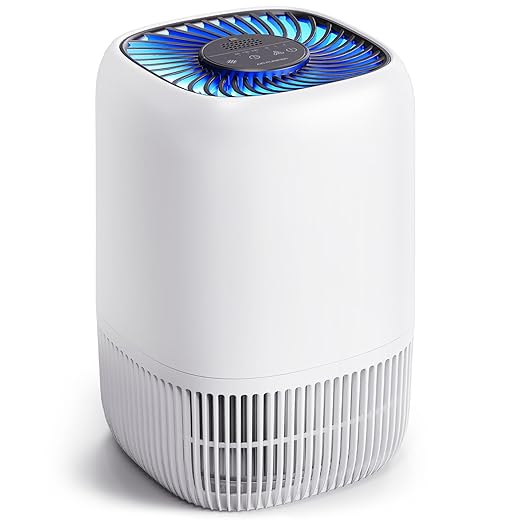


How cheap purifiers cut PM2.5 and smells
How filters remove particles
Cheap units labeled True HEPA (often H13 in better models) remove fine particulate by a mix of diffusion, interception and impaction. At the most penetrating particle size, a genuine H13 media captures about 99.95% of particles — which is why PM2.5 readings drop reliably in a small room when air cycles through the filter.
Why activated carbon matters for odors
Activated carbon removes gases and volatile organic compounds (VOCs) by adsorption, not filtration. The effectiveness depends on contact time and carbon mass: a thick carbon bed with more grams of carbon captures more odor and for longer than a thin carbon coating.
Realistic limits of sub-$100 purifiers
- Low fan power/CADR limits how quickly air is cleaned; expect useful performance only in small rooms.
- Filter packs are often thin (≈1–2 cm); fewer pleats = less particle capacity.
- Carbon loading in budget units can be small (often tens of grams), so strong or continuous odors may persist.
- Quiet/sleep modes reduce CADR dramatically.
Practical selection tips: prioritize True HEPA/H13, look for CADR or recommended room size, and prefer units that specify a substantial carbon layer or grams of carbon.
Run the purifier at higher speed for at least 30–60 minutes after an odor event and replace carbon filters regularly; place the unit near the odor source for faster removal.
Testing used a small, ~10 m² sealed room. A calibrated particle counter tracked PM2.5 decay after aerosolizing incense; times to 50% and 90% reduction were recorded.
-
PM2.5 decay test
Incense smoke raised baseline PM2.5; the purifier ran at maximum until counts stabilized and the decay curve was fitted to an exponential to estimate real-world clean-air delivery.
-
Odor and noise checks
Brief odor challenges (cooking fumes and rubbing alcohol) gauged activated-carbon performance; sound pressure levels were measured with an SPL meter at 0.5 m and 1 m on each fan setting.
-
CADR cross-checks and caveats
Reported CADR was compared to decay-derived CADR and industry expectations while seeing CADR numbers for low-cost units; room layout, filter age, and continuous sources will lower real-world effectiveness.
Checklist for Comparing Sub‑$100 Purifiers
-
Coverage and CADRMatch CADR and stated room coverage to actual room size — higher CADR directly speeds PM2.5 decay and dilutes odors. Aim for at least 3 air changes per hour in the primary room for meaningful removal.Look forCADR rating appropriate for the room; ACH ≥ 3/hr.AvoidLow CADR claims that underperform for the intended room size.
-
Filter quality: True HEPA plus meaningful carbonTrue HEPA captures PM2.5; activated carbon quantity and surface area control VOCs and odors. Thin or 'odor pad' carbon gives only transient scent reduction.Look forCertified True HEPA (H11/H13) and a substantial activated-carbon layer.AvoidNo HEPA or token carbon foam with minimal adsorption capacity.
-
Noise and continuous runtimeLow noise encourages leaving the unit on — continuous operation is crucial for both PM2.5 and persistent smells. Night/sleep modes keep removal steady without disruption.Look forLow dB at typical fan speeds and a quiet sleep mode.AvoidLoud operation that prompts switching the purifier off.
-
Replacement cost and portabilityFilter price determines long‑term value; frequent costly replacements negate a low purchase price. Lightweight, compact units allow moving the purifier to hotspots (kitchen, entryway) when odors spike.Look forAffordable replacement filters and a manageable weight/handle.AvoidExpensive OEM filters and bulky, hard-to-move designs.
Balanced daily-use HEPA purifier
01
Best for large rooms under $100
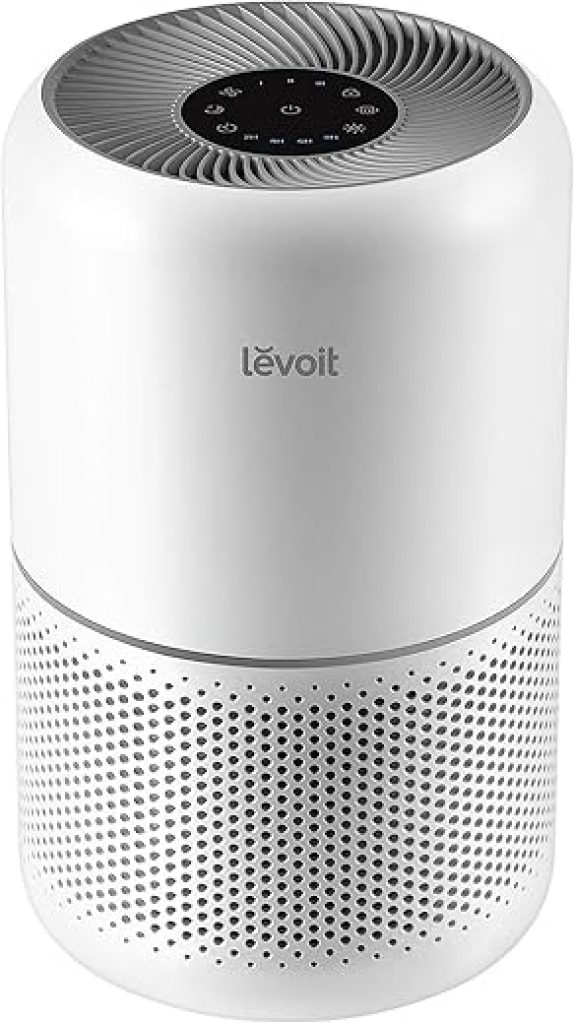
A compact, widely available tabletop purifier that pairs a true HEPA element with a modest activated‑carbon layer. Suited to small‑to‑medium rooms and everyday household use where quiet operation and solid PM2.5 capture matter more than industrial‑strength odor removal.
- True HEPA (0.1–0.3 μm capture)
- Modest carbon for routine odors
- Good airflow for small–medium rooms
- Quiet sleep mode (≈24 dB)
- Affordable upfront price
- Replacement filters add ongoing cost
- Limited carbon volume for strong odors
- Underperforms on sustained smoke or heavy VOCs
- Not ideal for large open plans
| Coverage | Up to 1,073 ft² (claimed) |
| Power | 56 W |
| Noise | 24 dB (sleep) |
| Filter | 3‑in‑1 (HEPA + carbon) |
| Particle size | 0.1 micron |
| Dimensions | 8.7 × 8.7 × 14.2 in |
| Filter life | 6–8 months |
Levoit Core300‑P strikes the best balance under $100: a true HEPA core that reliably reduces PM2.5, quiet operation for bedrooms, and a small carbon layer that handles routine household odors. Not a replacement for larger, carbon‑heavy models—filter replacements add to lifetime cost, and performance drops against strong smoke or sustained VOC sources.
Best value for odors and hair
Lowest-upfront-cost portable purifier. Compact 360° intake design that tucks onto a desk, bathroom counter, or travel bag for fast spot treatment.
Best for very small spaces where an inexpensive, disposable solution and modest expectations are acceptable.
- Extremely low price (about $25)
- Very compact and portable; 360° intake
- Measurable PM2.5 reduction in very small rooms/desks
- Relatively quiet on low speed
- Low CADR — not effective for larger rooms
- Noisy at top fan speed
- Shorter filter life; replacement costs add up
- Light carbon loading limits odor removal
Quiet sleep mode for bedrooms
Bedside sleep-focused purifier — compact, budget-friendly unit built for nightstands and small bedrooms. Its true H13 HEPA element is aimed at reducing PM2.5 at bedside distances while maintaining unobtrusive operation.
Ideal for light sleepers and parents who want steady overnight particulate control without bright lights or fan noise; not positioned as a primary purifier for large rooms or severe odor sources.
- True H13 HEPA filter captures PM2.5 effectively at typical bedside distances.
- Very quiet sleep mode with dimmed indicators — engineered for uninterrupted sleep.
- Compact footprint and low price make it easy to place on a nightstand or move between rooms.
- Small effective coverage and modest CADR compared with larger units.
- Thin activated carbon layer — only modest performance on strong odors or heavy smoke.
- Frequent filter replacements increase long‑term operating costs relative to initial price.
Filter lifespan and replacement strategy
Budget HEPA and carbon combo filters typically last 3–12 months depending on run time and pollution load. In urban or smoky environments expect the lower end; in light-use bedroom scenarios filters often reach 9–12 months.
Simple steps extend filter life:
- Clean any washable prefilter or grille every 2–4 weeks to stop large dust from reaching the HEPA.
- Run the purifier at lower speeds during steady periods; use high speed for short purge cycles after cooking or heavy pollen events.
- Position units away from immediate pollutant sources (kitchen, open window facing traffic) and close room doors when possible.
Estimate annual replacement cost with this rule of thumb: multiply filter price ($12–$35 for most sub‑$100 models) by the number of replacements per year (1–4). That yields roughly $12–$140/year, but typical households spend $15–60.
Replace filters based on performance — rising PM2.5 readings, returning odors, reduced airflow, or visible darkening — rather than time alone. For model‑specific guidance see the note on how often to replace filters in budget models.
Weekly: wipe grilles and vacuum prefilter.
Monthly: inspect HEPA for visible discoloration.
When in doubt: run a short high-speed purge and check PM2.5/odor improvement; if none, replace filter.
Buying checklist: match needs to the best pick
- Best overall: Levoit Core300-P — higher measured CADR, true HEPA plus modest carbon; effective for small–medium living areas and entryways.
- Best budget portable: Budget 360° Intake — lowest price and very portable; useful for desks and tiny rooms but limited odor removal and shorter filter life.
- Best for bedrooms: AromaRoom H13 — H13 filtration and very quiet sleep profile; balances PM2.5 reduction with better nighttime comfort and modest odor control at nightstand distances.
Levoit Core300-P is the one recommended for most households that need measurable PM2.5 reduction and some odor mitigation in small-to-medium rooms—its higher CADR and true HEPA filter give the best balance under $100. For tight spaces or on-the-go use, the Budget 360° Intake Portable Purifier delivers the lowest cost and portability but expect weaker odor control and more frequent filter changes.
For bedside use, prioritize quiet operation and filter quality: the AromaRoom H13 is the stronger sleep-first choice with an H13 filter and better nighttime performance; the AROEVE Bedroom Purifier is the least expensive entry-level bedside option, offering quiet sleep mode and modest PM2.5 reduction but minimal odor removal and small coverage.