Want pressure without a sauna? Find a cooling weighted blanket that actually sleeps cool.
Waking up soaked because a weighted blanket felt like a hug that turned into an oven is a familiar frustration. Many seek the calming pressure but dread the extra heat.
The central trade-off is pressure versus thermal load: weight, fabric and internal layers determine how much heat is trapped. Below are two quick picks — one budget light option and one purpose-built cooling design — to match different needs.
Best cooling weighted blankets

Why cooling matters as much as weight
A weighted blanket changes more than bedtime comfort — it changes the microclimate next to the skin. Because heavier materials add thermal mass, they store and radiate heat; tightly woven covers increase insulation and slow heat loss; and reduced fabric porosity limits airflow, trapping warm, humid air against the body.
Those physics produce measurable consequences. Elevated skin temperature and trapped moisture increase sweat and discomfort, which raise nocturnal awakenings. A delayed decline in core temperature interferes with the onset and maintenance of deep sleep and REM, so heat buildup can fragment sleep cycles and reduce restorative sleep.
Some sleepers face greater risk: people who naturally run hot (hot sleepers), menopausal or peri‑menopausal individuals with night sweats, people with higher body mass, children, and anyone in warm or poorly ventilated bedrooms. For these groups, a correctly chosen blanket can be the difference between calming pressure and overheating.
Cooling features — breathable fills, moisture‑wicking covers (Tencel, percale), sewn channels for air movement, and lower fabric density — are not optional extras. They directly counter the thermal effects of weight and should be considered equally when choosing a blanket.
Cooling equals safety and effectiveness. Prioritize breathable materials, moisture‑wicking covers, and construction that promotes airflow as much as the blanket’s weight.
Cooling technologies compared
Different cooling approaches work by either moving heat away from the body, shedding moisture, or creating air channels. Below is a concise comparison of the main technologies and when each is most effective.
How they work (and what they’re good for)
- Natural breathable fibers (Tencel, bamboo, cotton). Move moisture and allow airflow through the fabric. Pros: soft, inherently breathable, durable. Cons: less effective at actively reducing skin temperature. Best for mild warmth or damp climates where breathability matters.
- Synthetic wicking finishes (treated polyester blends). Pull sweat into the fabric surface to evaporate quickly. Pros: fast-drying, lightweight. Cons: can feel plasticky, finishes wear over time. Best for occasional night sweats or active sleepers who sweat intermittently.
- Phase-change materials (PCMs, e.g., Outlast-type finishes). Absorb or release heat to keep surface near a target temperature. Pros: perceptible cooling effect without active airflow. Cons: limited heat capacity—will saturate over many hours; performance varies with ambient temperature. Best for mild-to-moderate warmth or transitional seasons.
- Perforated or ventilated fill (perforated glass beads, hollow microbeads). Increase internal airflow and reduce insulation. Pros: keeps blanket lighter and less insulating. Cons: perforations can only do so much when weight compresses layers. Best for hot sleepers who still want substantial weight.
- Airflow-focused construction (channel quilting, mesh panels, dual-layer covers). Create paths for heat to escape and let air circulate. Pros: works continuously and doesn’t rely on chemical finishes. Cons: adds manufacturing complexity; effectiveness depends on bed setup. Best for chronic night sweats when combined with breathable materials.
Real-world limits and quick guidance
No single tech eliminates heat entirely. PCMs cool for hours but can saturate; wicking helps evaporation but doesn’t lower ambient heat; perforated beads reduce insulation but can’t overcome trapped body heat under multiple covers. For chronic, heavy night sweats, prioritize airflow-focused construction plus breathable covers and consider separate cooling bedding systems. For mild warmth, natural breathable fibers or PCM-treated fabrics usually suffice.
Fill and shell: pick low‑heat builds and easy‑care covers
Fill: prioritize low thermal mass
Thermal mass determines how much heat the blanket stores. For the coolest sleep, prefer fine glass microbeads or small polymer pellets rather than bulky natural batting (cotton, wool) or dense steel shot. Glass microbeads pack weight into tiny pockets, giving the same calming pressure with less trapped air and lower insulation.
Key choices:
- Low‑thermal‑mass fills: glass microbeads, fine plastic pellets.
- Higher‑insulation fills to avoid: wool, thick cotton batting, heavy foam layers.
Shell: breathability and washability matter
The shell controls airflow and how often the blanket can be cleaned. Look for tightly stitched, breathable fabrics such as Tencel or a high‑gsm cotton weave for airflow plus durability. The single best practical move is a removable duvet cover: the insert can be weighted while the cover goes in the washer.
Care checklist:
- Machine‑washable shell or removable cover (cold, gentle cycle).
- Sealed channels and precision stitching to stop bead leakage.
- Line dry or low heat tumble to protect adhesives and seams.
Allergy‑safe options and certifications
For sensitive sleepers, avoid feather or wool fills and choose labeled hypoallergenic synthetics. Seek verified credentials such as OEKO‑TEX Standard 100 or organic certifications; look also for asthma/allergy endorsements. Explore hypoallergenic cooling options for sensitive sleepers when high reactivity is a concern.
Small design details—many small pockets, reinforced seams, and a washable cover—produce the biggest real‑world cooling and maintenance gains.
If cooling is the priority: choose fine glass‑bead or polymer fills + a breathable, removable shell. Avoid thick natural batting and non‑washable designs.
Construction that breathes
Construction choices determine whether a weighted blanket traps heat or lets it escape. Two airflow levels matter: macro airflow between skin and blanket and micro airflow through the shell and fill.
How stitching and box design affect heat
- Box size: larger chambers (about 3–5 in / 7–13 cm) create loft and internal channels for air; very small boxes concentrate weight, compress fill, and trap heat.
- Quilting density: dense quilting (many stitches per area) flattens the fill and reduces ventilation. Prefer fewer, well‑spaced stitches for better breathability.
- Channel vs. box stitching: long channels move weight without compressing a single spot and encourage airflow along the length; box stitching distributes weight but can create localized hot spots if boxes are tiny.
- Edge and vent design: flat, piped edges prevent heat pockets; intentional vents, mesh panels, or dual‑layer constructions with an air gap improve cooling.
Choosing the right combination reduces trapped heat and avoids localized hot spots while keeping weight distributed.
For hot sleepers:
Favor larger boxes (3–5 in) and lower quilting density. Look for channel stitching or vents and a breathable shell fabric. Avoid densely stitched, heavily quilted blankets that compress the fill.Pick a weight that cools, not smothers
How to adjust the 10% rule
Start from the familiar guideline—blanket weight ≈ 10% of body weight—but reduce it for cooling. Use 8% of body weight as the target (round to the nearest 2 lb). Example: a 150 lb person → 12 lb (150 × 0.08). For very small or large bodies, stay between 7–25 lb; extreme sleepers can add ±2 lb for preference.
Couples, mattress type, and seasons
For couples, two single blankets is the best cooling solution. If sharing is necessary, calculate 8% of combined weight, then subtract 6–8 lb to avoid excess heat and bulk—round to the nearest available size. As a rule of thumb, many couples find 18–22 lb king blankets comfortable and cooler than heavier options.
Mattress matters: memory-foam or pillow-top beds trap heat, so reduce chosen weight by 1–3 lb or prioritize a cooling shell. Innerspring/hybrid beds feel cooler and usually need no adjustment—see mattress types that complement cooling weighted blankets.
Seasonal tips and warm climates
- Summer: drop 4–6 lb or switch to the cooling side of a reversible blanket.
- Warm climates: aim for 6–7% body weight, breathable shell, and glass‑bead fill for best airflow.
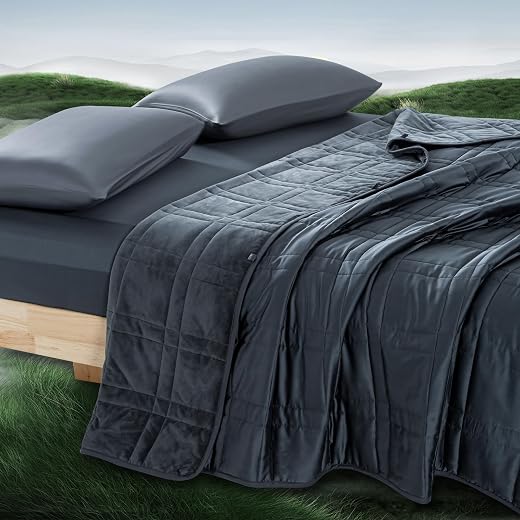
Best for couples who want a cooling option
Reversible: 300TC Tencel (cool) on one side, 330GSM velvet (warmer) on the other.
7-layer construction with glass bead fill and tight 6.3″ x 6.3″ stitched pockets for even distribution.
King 88″ x 104″; 20 lb option suits many shared‑bed scenarios while offering a cooling Tencel face.
Testing uses controlled lab measures plus multi‑night home trials to separate marketing claims from real cooling performance. Methods quantify skin‑surface temperature change, drying time, thermal images, and subjective comfort.
-
Skin-surface temperature (delta)
A heated plate in a climate chamber records baseline and 30‑minute temperatures under the blanket; results reported as delta °C and ranked within the category.
-
Drying-time and thermal imaging
Saturated samples dry-timed at fixed temperature/airflow to gauge moisture shedding; infrared scans reveal hotspots and restricted airflow.
-
Home trials, scoring, and limits
Seven-night panel trials collect sleep-quality, sweat events, and perceived coolness; final cooling score weights lab metrics 70% and subjective data 30%. Note limitations: chamber tests omit mattress, cover layers, and individual physiology, so real-life cooling varies.
Immediate filter: essentials and red flags
-
Breathable shellThe outer fabric controls most airflow; choose Tencel, percale cotton, or open‑weave blends. Dense velour or heavy polyester commonly traps heat.Look forLight, openweave natural or moisture‑wicking fabricAvoidThick velour, heavy polyester, or tightly knit covers
-
Low‑heat fillGlass microbeads and small pellets shed heat faster than cotton or dense fiber fills. Large clumping fills hold warmth and slow drying.Look forGlass beads or fine pellets with even distributionAvoidThick fiber batts or loose clumping fills
-
Breathing constructionLarger box channels, simple quilting, and fewer dense stitch lines permit airflow and reduce hotspots. Over‑quilted patterns restrict ventilation.Look forBox or channel quilting with moderate stitch densityAvoidTight quilting, many small boxes, or glued pads
-
Right weight and fitChoose the 6–10% body‑weight rule and size to mattress; oversized or overly heavy blankets increase skin contact and trap heat.Look forWeight near 8% of body mass and correct blanket sizeAvoidExcess weight or oversized blanket for mattress
Cooling-weighted blanket myths, debunked
Weight alone doesn’t determine heat; material, fill density and airflow do.
A heavy blanket built with glass microbeads and a breathable shell can move more air and dry faster than a lighter, densely quilted cotton blanket.
Cooling claims cover different mechanisms—wicking, phase change, cool-to-touch finishes, and weave openness.
Some finishes fade or rely on perception, while mechanical breathability and moisture transport show in thermal tests.
Microglass beads are small, disperse weight evenly, and rarely add insulation.
Beads create thin, flexible fill layers that promote airflow and faster moisture evaporation compared with thick batting.
Many cooling shells and bead fills withstand machine washing when care instructions are followed.
Permanent structural features (weave, fill) persist; topical coatings and some finishes may diminish over many washes.
How to pick the right weight for cooling?
Use the 8% body-weight guideline as a starting point but choose the lower end if prone to overheating; consider mattress firmness and seasonal swaps for cooler sleep.
Is Tencel better than cotton for cooling?
Tencel typically wicks moisture and breathes better than standard cotton, though a lightweight percale cotton can perform well if constructed for airflow.
Do cooling treatments and finishes wear off?
Yes—surface finishes and some PCM coatings can lose effectiveness after repeated washing; structural cooling (weave, fill type) remains more durable.
Can a cooling weighted blanket replace air conditioning?
No; it lowers skin temperature and improves perceived comfort but does not cool room air—best used alongside ventilation or modest AC settings.
What's the best way to test cooling performance before buying?
Look for return trials, independent lab metrics (skin-surface Δ°C, drying time), and consistent user reports about nighttime sweat and hotspot behavior.
Quick shopping plan: shortlist, test, inspect
-
Shortlist with strict filters
Filter for breathable shells, low‑thermal‑mass fills (glass beads/pellets), ventilated construction, washable cover, and weight at or below ~8% body mass.
-
Prioritize shell + fill first
Choose Tencel, linen, or open‑weave cotton shells paired with glass beads or pellets—these combinations move heat away fastest.
-
Pick a conservative weight
If prone to heat, select about 0.5–1 kg under the usual recommendation or consider split/dual blankets for couples.
-
Run a two‑night test
Sleep with regular bedding and thermostat settings for two nights; note sweating, sticky sensations, or dampness on the surface.
-
Inspect on arrival
Check seams, even bead distribution, odor, care label, and return window before the first wash.
Also consult the linked guides below for complementary mattress, pillow, and bedroom‑temperature strategies.

Final checklist: choose, test, return
- Calculate a conservative target weight (around 8% of body weight) and round down for warm sleepers.
- Prefer low‑thermal‑mass fills (glass microbeads/pellets) and breathable shells like Tencel or percale.
- Check construction: larger baffles/box stitching and minimal batting improve airflow and reduce hotspots.
A safe, practical approach prioritizes correct pressure plus breathable construction and low‑thermal‑mass fill. Aim for a conservative target weight (roughly 8% of body weight, often rounded down for warm sleepers) and choose a shell and quilting that maximize airflow—Tencel or percale covers, larger baffles, and minimal insulating batting. Glass‑microbead or pellet fills and thin, washable covers reduce stored heat.
Test the blanket at home with the mattress and bedding that will be used. Allow a two‑night trial where possible, check for dampness or rising skin temperature, and use the seller’s return policy if it sleeps hot. If overheating occurs, switch to a lighter weight, a cooling topper, or a different fill.