Stop squeezing into tight cuffs — inaccurate home readings can alter treatment decisions.
Wrestling with a cuff that won’t close, frequent cuff too small errors, or readings that jump 10–20 mmHg is common for muscular or conical arms. Choose a monitor with a true XL or tapered cuff, a long bladder that centers over the brachial artery, and a compatible connector so home measurements remain clinically useful.


Why cuff geometry—not marketing—drives accuracy
How geometry affects readings
Blood pressure cuffs work by transmitting external pressure from an inflatable bladder to the brachial artery. On large or conical arms the bladder no longer matches the arm’s radius and contour, so the pressure delivered to the artery is systematically distorted. A bladder that is too narrow for the arm requires higher cuff pressure to occlude the artery, producing false high readings; a poorly shaped or non‑conforming bladder can create air gaps and uneven compression that also bias the result.
The physical reason is simple: the effective pressure on the artery depends on bladder width, length and how uniformly it wraps the arm. Recommendations from validation protocols reflect that: a bladder width of roughly 40% of mid‑arm circumference and a length covering about 80% of the circumference give the most consistent transmission of pressure. Deviation from those geometry rules produces predictable, repeatable errors — not random noise.
What to check and why it matters
- Measure mid‑arm circumference before buying and compare to the cuff’s actual bladder dimensions (not just the label).
- For conical arms, prefer tapered/contour cuffs that reduce air gaps and uneven compression.
- Ensure the cuff will wrap snugly with proper overlap; extra padding or loose placement increases bias.
These geometric issues can shift readings by several to tens of mmHg — enough to change diagnosis or medication decisions. Prioritize correct bladder geometry over brand claims.
Systematic cuff errors can falsely raise or lower BP by 5–20+ mmHg. That magnitude can trigger unnecessary medication changes or mask uncontrolled hypertension. Always confirm bladder dimensions and fit before relying on readings for treatment decisions.
Form factors compared
When arm shape is the main challenge, form factor determines whether readings are biased or usable.
- Upper-arm monitors — best for large/conical arms. Pros: cuff sits at the brachial artery, wide/tapered bladders available, validation studies often include upper-arm models. Cons: cuff fit must encircle 80% of the arm; cylindrical cuffs can create proximal gaps on conical arms. Recommendation: choose models offering true XL or tapered/conical cuff options and D‑ring or single-wrap closures for a snug, even seal.
- Wrist monitors — convenient but less reliable on conical arms. Wrist position, artery depth, and posture make systematic errors more likely. Accept only if anatomical or mobility limits prevent upper‑arm measurement; insist on validated wrist models and additional readings.
- Forearm and ambulatory cuffs — middle ground. Can work when manufacturers supply appropriately shaped bladders; verify cuff geometry and validation data.
Action checklist:
- measure mid‑arm circumference
- match cuff bladder length to 80% arm circumference
- prefer validated upper‑arm monitors with tapered XL cuffs
Best choice: upper‑arm monitor with a true XL or tapered cuff — highest accuracy for conical arms.
Priority checklist for product pages
-
Explicit cuff size and dimensionsProduct pages should list numeric arm-range and cuff bladder length/width so buyers can compare to measured arm circumference.Look forExact XL/XXL range plus bladder length and widthAvoid'Universal' or 'fits most' without dimensions
-
Clinical validation detailsClear statement of validation standard (AAMI/ESH/ISO) or citation of a published validation study increases confidence in accuracy.Look forNamed validation protocol or published study referenceAvoidVague 'clinically tested' claims with no standard
-
Replacement cuff availabilityManufacturers that sell model‑specific XL/XXL replacement cuffs make long‑term accuracy maintenance practical.Look forReplaceable XL/XXL cuff sold separately with part numberAvoidIntegral or no listed replacement cuffs
-
Cuff geometry and photosLanguage or images that describe a tapered or oblong bladder indicate design for conical arms; photos should show the cuff on larger arms.Look forTapered/oblong bladder description and fitting photosAvoidOnly generic photos or no bladder-shape information
Confirm arm measurement and cuff bladder placement
-
Locate midpoint
Find halfway between shoulder and elbow; mark it.
-
Measure circumference
Use a fabric tape snug to skin (no compression); record in centimeters.
-
Check bladder coverage
Bladder should cover roughly 80–100% of circumference; compare measurement to the cuff specs.
-
Position cuff
Place cuff 2–3 cm above the elbow with the artery marker over the brachial artery; smooth the fabric to remove gaps.
-
Confirm fit
Take a single reading; if the cuff slips or leaves gaps, try a different cuff size or shape.
If the arm tapers >6 cm between the biceps and just above the elbow, prefer a tapered/conical cuff. Measure both the larger and smaller circumferences; if only straight cuffs are available, ensure the bladder covers the larger measurement and watch for gaps at the narrow end.
How monitors were tested for large and conical arms
Controlled bench and clinical comparisons established device accuracy for large, tapered arms. Devices were benchmarked against a calibrated mercury-standard sphygmomanometer and a hospital-grade reference across repeated measures.
-
Reference protocol
Simultaneous-sequential paired readings (30+ per arm size) with Bland–Altman plots and mean bias to quantify agreement.
-
Arm-shape panel
Human subjects covered cylindrical and conical anatomies across three circumference bands (large, XL, XXL); cuff centering and overlap were verified.
-
Real-world conditions
Measurements repeated after light activity, with varied cuff temperatures and multiple operators to capture fitting errors and operator variability.
Clinical-validation status (ISO 81060-2 or AAMI) is flagged for each model.
Key fit and construction features

Common myths that steer buyers wrong
Marketing ‘XL’ sizes vary; true fit depends on bladder dimensions.
Brands use inconsistent labeling; measure arm circumference; compare bladder length and width to specs.
Stretch doesn’t correct mismatched bladder geometry.
Excess material can create gaps or uneven pressure on tapered arms, biasing readings.
Width helps, but bladder length and placement determine measurement validity.
Too-wide bladders that don’t encircle the arm produce inconsistent compression and false pressures.
Short practical answers
Will a monitor's Bluetooth/USB integrate with clinic systems?
Rarely directly. Home devices use proprietary apps; clinics need standard exports (HL7/CSV) or validated-device reports—confirm vendor specs or bring printouts.
Will clinicians accept home readings?
Yes when the monitor is clinically validated and the cuff fits. Provide validation info, cuff size, and measurement method for review.
How to manage conical (tapered) arms?
Use a tapered/anatomical XL cuff and follow placement guidance. If unavailable, use a validated forearm or wrist device as an alternate.
Do monitors need regular calibration?
Users can’t recalibrate at home; follow manufacturer service intervals (often 1–2 years) or after impact. Confirm with occasional clinic comparisons.
Best overall for large arms
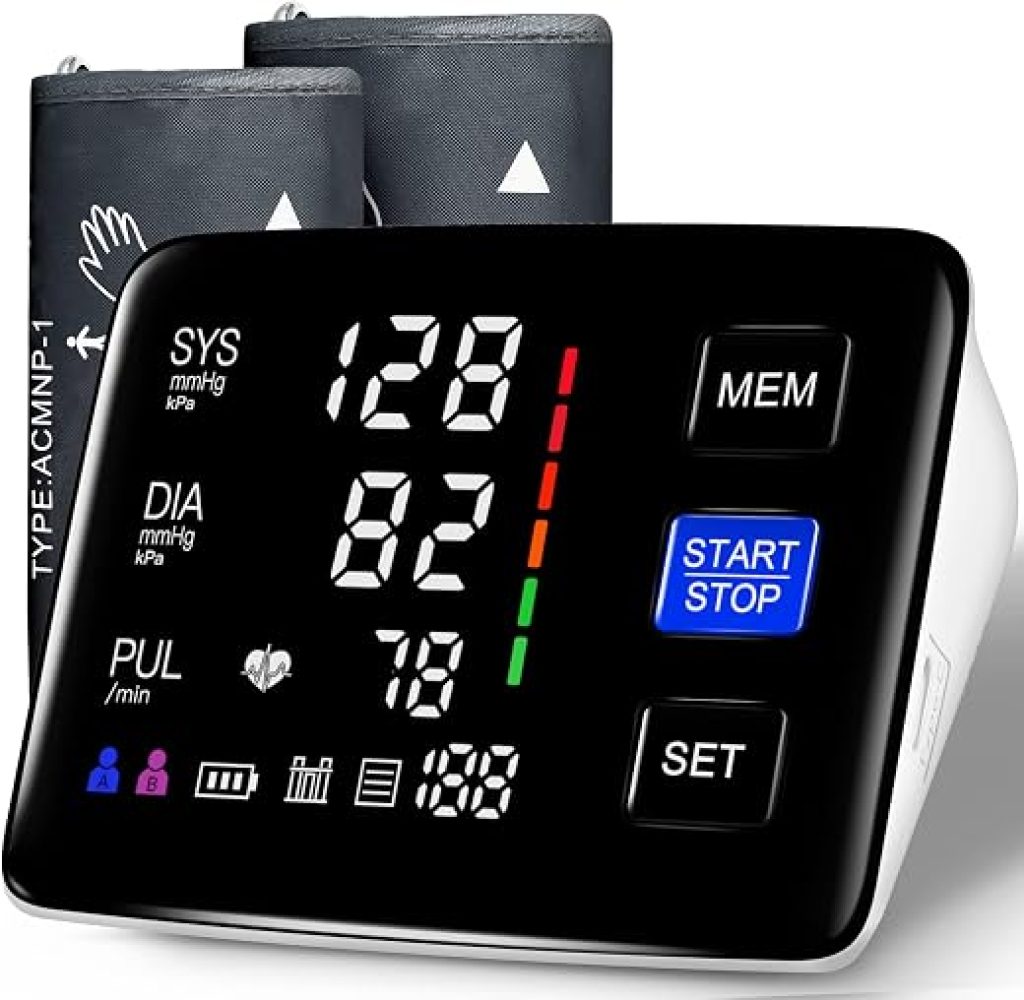
Two true large cuffs (9–17″ and 13–21″) cover most large and XL upper arms. Features an LED color backlit screen, automatic oscillometric measurement, and both USB and battery power (4×AAA). Compact housing and clear display make readings easy to read; listed price about $45 on Amazon. Fit-first design: the included cuff ranges remove guesswork for many conical arms. Clinical validation is not listed on the product page — prefer clinically validated models for diagnostic decisions.
This monitor earns the best‑overall slot on fit alone: the paired cuff options span 9–21″ upper arms, so the bladder geometry can be matched instead of stretched. For large or tapered arms, selecting the larger 13–21″ cuff avoids under‑wrapping and the systematic overestimation that small cuffs cause.
Two practical notes: measure the mid‑upper arm circumference and use the cuff that places the bladder over the brachial artery. The product page does not cite independent clinical validation; for treatment decisions, prefer a device with published validation or check with a clinician before relying on home readings.
Extra-large upper-arm monitor (42–60 cm)
A&D UA-789AC pairs a true extra‑large cuff (16.5–23.6 in / 42–60 cm) with A&D’s clinical-grade inflation algorithm. The unit includes an AC adapter, single-user memory, and a rigid casing built for frequent home use. Its long, wide cuff covers more of the arm and keeps the inflatable bladder centered — attributes that reduce systematic bias on very large or conical upper arms. Good choice when standard XL cuffs are too short or produce inconsistent readings.
| Cuff range | 42–60 cm |
| Bladder | Long, wide bladder |
| Format | Upper-arm |
| Power | AC adapter |
| Price | ~$130 |
Why this works for conical arms
A long, wide cuff reduces two common errors on tapered upper arms: undercuffing (insufficient coverage) and oblique bladder inflation (bladder sitting at an angle). Covering more circumference keeps the bladder centered over the brachial artery and spreads pressure evenly, which lowers systematic bias.
Practical tips
- Measure mid‑upper arm and confirm the cuff’s 42–60 cm range fits comfortably.
- Position the bladder center over the artery and tighten so the cuff contacts the arm uniformly; avoid one‑sided gaps.
- For extreme tapering, consider a tapered or two‑piece replacement cuff if readings remain inconsistent.
A&D’s UA‑789AC is recommended when length and bladder width are the primary fit concerns; its extra‑large cuff is the simplest first fix for conical arms.
When the monitor body is fine but the cuff doesn’t fit, source a true XL or tapered cuff with matching bladder length and width. Prefer manufacturer replacement cuffs or high-quality third‑party XL cuffs such as the ELERA Extra Large (9″–24″ / 22–60 cm) — an affordable ~$20 option on Amazon with six connector types for broad compatibility.
Key buying checks
- Confirm bladder length and width match measured arm circumference.
- Match connector type or use a universal adapter (check 2‑pin / 6‑pin compatibility).
- Avoid simple fabric extenders: they add circumference but not bladder coverage, so they can introduce bias.
- For very large or conical arms, opt for a professional wide/long clinical cuff rather than only an extender.
If unsure, measure the arm and compare cuff bladder dimensions before purchase.
Purchase and first‑use checklist
- Measure mid‑upper arm circumference and note conicity.
- Buy a clinically validated XL or tapered cuff that matches bladder dimensions.
- Confirm replacement‑cuff availability and review return/warranty terms before purchase. On first use, fit the cuff exactly and take duplicate, rested readings. Compare home readings with clinic measurements within two weeks; record device model, cuff size, and serial number, and bring them to the clinician to confirm targets and technique.
Before buying: Measure mid‑upper arm circumference and arm shape; choose a clinically validated XL or tapered cuff, verify replacement‑cuff availability and the seller’s return/warranty terms. First use & follow‑up: Fit the cuff per instructions, take duplicate rested readings, and compare home readings with clinic measurements within two weeks.